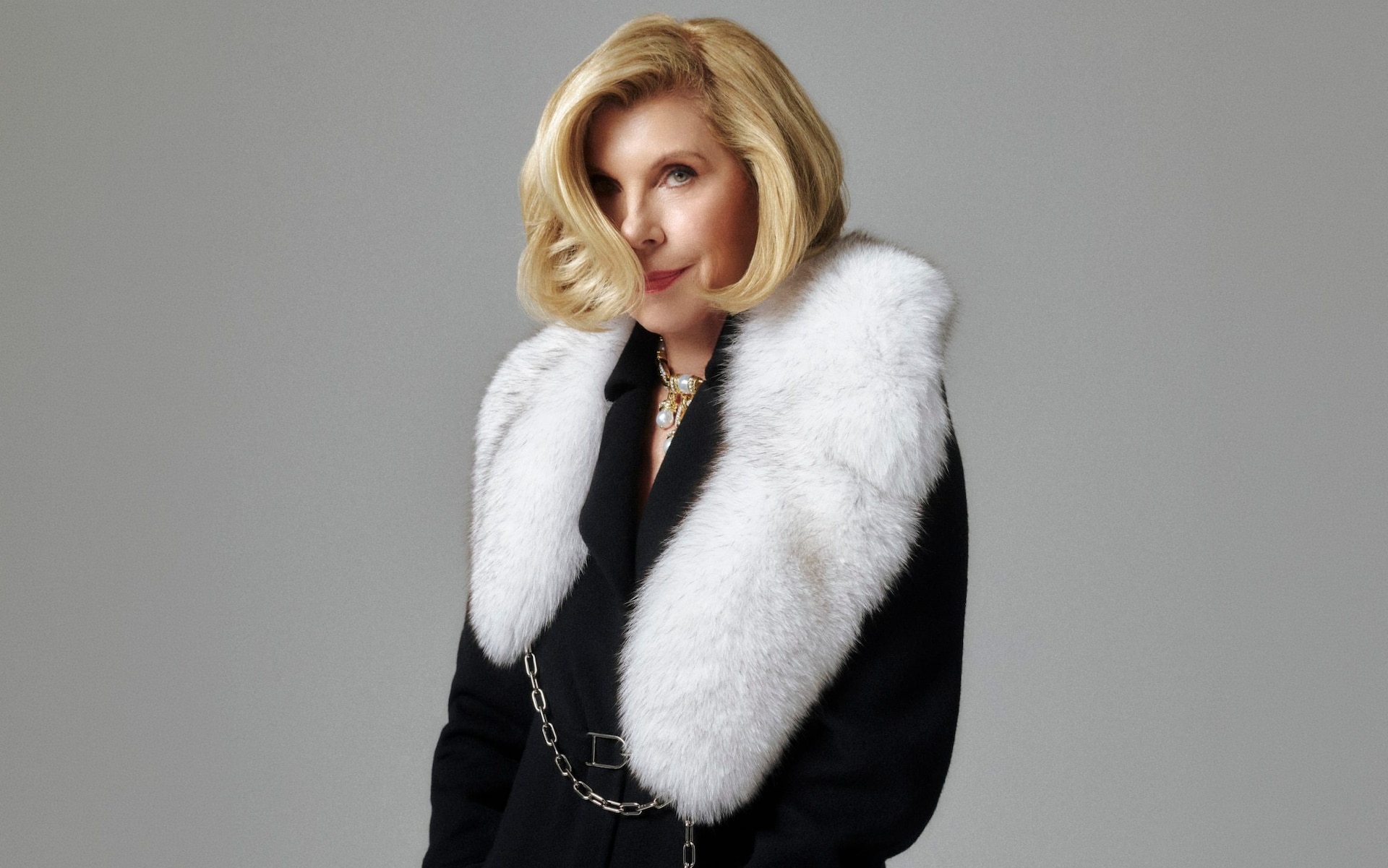
CHRISTINE BARANSKI INTERVIEW: AMERICA’S TV DARLING HITS THE WEST END
“I think,” Christine Baranski says, “that people tend to put too much of a lens on the close-up of their life. They’re thinking, ‘How am I going to get through the day’ and ‘This person’s a pain in the a--’, whereas if you just look through the wide lens, life is rather magnificent, isn’t it?”
Heads turn as Baranski walks into the lounge bar of the hotel in Bloomsbury, London. Tall, striking and radiating glamour, she is wearing a cream suit and a crisp white shirt, with outsized sunglasses. Her hair is the colour of champagne. She is 74 but looks 10 years younger. You would know that she was someone, even if you couldn’t immediately be quite sure who.
In Britain, Baranski is perhaps most recognisable for her fizzing comedic role in the film Mamma Mia!, as Tanya, best friend to Meryl Streep’s Donna, and more recently as Agnes, the sharp-tongued matriarch of the “old money” van Rhijn family in The Gilded Age, Julian Fellowes’s hugely popular successor to Downton Abbey.
In the United States, she is showbusiness royalty, a star of stage, cinema and television, the winner of a clutch of Tony, Emmy and other awards, and a perennial favourite, wise-cracking guest on US chat shows, described by host Stephen Colbert as “America’s treasure”.
She is now about to make her West End stage debut, starring with Richard E Grant in the Noël Coward comedy Hay Fever. Set in an English country house in the 1920s, the play sees Baranski portray Judith Bliss, a retired actress, frustrated and contemplating a return to the stage, married to a preoccupied playwright, with two adult children. Havoc ensues when each member of the family invites their potential romantic interest to spend the weekend. The new production is billed as “a comedy of appalling manners”.
Coward wrote the play in 1924, inspired by a weekend house party at the New York home of the actress Laurette Taylor and her husband, the playwright Hartley Manners. Appalled by their rude and tactless behaviour to their guests, Coward took to calling the couple the “Hardly Any Manners”. Laurette Taylor was reportedly not best pleased by the play.
Baranski is a long-term fan. Coward’s Private Lives was the first show she ever saw on Broadway when, as a teenager, she had come to New York with her mother to audition for a place at Juilliard, the US’s leading performing arts school. (She got the place.) And she has appeared in two Coward plays over the years – Private Lives and Blithe Spirit.
“Wonderful!” she says (a favourite word of hers), contemplating getting to grips once more with Coward’s highly mannered, brittle and cutting dialogue. “To speak that precisely, that clearly, that quickly, it’s a singular challenge, but it’s wonderful for me to dust off that skill set, because I’ve been doing television for a long time now.
“But I have to tell you,” she confides, “I’ve always admired the British acting style and been inspired by all these great actresses. I remember sitting in the balcony of Shea’s theatre in Buffalo when I was 18 years old seeing [the film of] Olivier’s Othello with this beautiful actress named Maggie Smith.
“I actually had lunch with the great Peggy Ashcroft when I was 19 – I had an entrée because of a Juilliard teacher of mine. But I’ve always been in awe of Judi Dench, Helen Mirren, Harriet Walter, uh, Julie Walters – I mean…” It is an effusion of praise in which no one should be forgotten. “Emma Thompson, Lesley Manville… just being here and being in a British company, to me, it’s a great treat, a great privilege.”
Coward, of course, was a marvellous self-invention. The son of a frequently impoverished piano tuner, who grew up in the London suburb of Teddington, Coward jumped social classes and reshaped himself as the epitome of urbane sophistication.
It is something Baranski recognises in herself. “Yes, Polish-American, respectable working class. I was very skinny, very shy. I had bad skin for years.”
And has she reinvented herself?
“You know,” she pauses. “Not to throw a curveball into this, but it pertains to what you’re saying…”
We are talking on the day that news has broken of the death of Dolly Parton, and the passing of the queen of country music is in everybody’s minds and conversation. “I had the great pleasure of working with Dolly Parton, in a Christmas show. So I was thinking, imagine that woman becoming an international superstar.
“She’s one of the great humans, in my opinion. And she came from nothing. And then I thought: Noël Coward! Same thing. Not that level of poverty, but he decided to be Noël Coward. And we still think of him in a silk robe, the cigarette, the witty bon mot.”
Buffalo, New York state, where Baranski grew up, is an industrial city that stands on the eastern end of Lake Erie, next stop: Canada. The Baranskis were Polish immigrants, and her father was the advertising manager for a Polish-language newspaper.
Her grandmother was an actress, “a flamboyant character”, Baranski remembers. “She had a marvellous theatricality and warmth, and she loved performers, she loved ballet, she loved music. And you know, what goes in early goes in deep. Nana went in deep.”
Her grandmother and father both encouraged her to go to ballet school; she acted in plays in high school and, outside it, was part of an avant-garde theatre group. “But I think I had in my mind’s eye an idea of wanting to be that sophisticated leading lady, you know? And it’s quite extraordinary to be Judith Bliss. It’s that thing of making your dreams come true.” She gives a beaming smile. “I know it sounds so clichéd, but, you know, here we are.”
At the age of 18, this “Polish Catholic virgin” went to Juilliard. In her first year she won an award for the most hard-working and most economically needy student, with a prize of $1,000. The money was to support her for the following year, but the next day she went to the passport office and, against her mother’s wishes, took off for Europe, seeing theatre wherever she went.
Baranski went on to perform in regional theatre across the US, off Broadway, and then Broadway. In 1984 she won her first Tony award for her performance in Tom Stoppard’s play The Real Thing. She acted in films – 9½ Weeks and, brilliantly, The Birdcage, opposite Robin Williams – “pi--ingly funny!” she exclaims. “It just never fails to make people laugh.”
But it was television that cast her in a new light for a mass audience. In the mid-1990s Baranski co-starred in the sitcom Cybill, featuring Cybill Shepherd, playing the role of Maryann Thorpe, the wealthy, sophisticated, sarcastic best friend of the main character, “with the martinis and the one-liners,” she says. She won an Emmy for her performance. “And because of the success of that, that was the first time I was recognised by a large audience. And that sort of thing can define you, like, ‘Oh, that’s who she is.’”
Baranski went on to play the role of lawyer Diane Lockhart in The Good Wife, and its sequel, The Good Fight, which together ran from 2009 to 2022. She describes her character as “sophisticated, well-spoken, whatever…”.
And now The Gilded Age, about to begin its fourth season. So here she is, now labelled “America’s treasure”. Is she comfortable with that?
“I am now. I always say I like to wear the mantle of whatever fame I have rather like a cashmere scarf, and not like a heavy velvet robe that you have to drag around.” She laughs. She knows it’s a good line.
“I really do think I have a very lovely level of fame. I can walk down the street, or be in a restaurant, and people don’t bother me. If they do, it’s not a bother, they tend to say nice things, like, ‘You’ve given me so much happiness,’ whether it’s about Mamma Mia! or Mamma Mia 2! Those two movies have brought so much happiness into the world.
“I’ve done a lot of things that have brought smiles to people’s faces, and that’s a wonderful thing.” In fact, she adds, “I’ve actually had people say: ‘A relative of mine was very ill or was dying, and saw your [film] and you gave them such joy.’ That’s a very satisfying thing for a performer. I like being that kind of performer that would delight people.”
In 1983, Baranski married Matthew Cowles, an actor she had met when both were performing in Henrik Ibsen’s Ghosts at a theatre in Long Island.
“The most unusual chap,” she says. “He had a black leather motorcycle jacket on, and an unfiltered cigarette dangling from his lips, and shaggy blonde hair, and I just thought he was so eccentric and sexy and interesting.
“Anyway, one night after rehearsal, he asked if I wanted a ride home on his motorcycle, which was a BMW that he named Lucifer. I’m on the back of the motorcycle, hanging on to the leather jacket. The rest, as I say, is history. And within a year we were married.
“He was such a highly intelligent but complicated guy, and wildly talented. He didn’t have the career that he should have had, because I think he…” she pauses. “He had real ambiguity about ambition.”
Cowles was the great-grandson of Joseph Drexel, patriarch of the banking dynasty that established a massive fortune in the mid-19th century, during the Gilded Age, and a great philanthropist. Baranski notes that she has learnt more about the family by acting in The Gilded Age than she knew about her husband at the time.
She and Cowles married in a Catholic church in Bethlehem, Connecticut, the town where he had grown up, driving away from the church on Lucifer with Baranski riding side-saddle in her wedding dress.
The couple went on to have two daughters, raising the family in the 18th-century farmhouse that Cowles had inherited from his mother. Isabel, now 41, is a lawyer, and Lily, 38, an actress.
In 2014 Cowles died of congestive heart failure, at the age of 69. Baranski was 62, about to go back to work on a new season of The Good Wife.
“And I remember being nervous because it’s so… I would say death is… death is not just sad, it’s disorienting. It’s so weird. Death is weird for the people left behind.
“When you lose a spouse with whom you lived for 30 years…” again she pauses. “Things aren’t quite right in so many ways. And I worried about my concentration, my ability to just focus.
“But work, because I worked with such wonderful people, and it was such a family, that did save me. It was a place to go and it was a place to put my energy. And, honestly, I’ve never stopped. I went from The Good Wife to The Good Fight, and while I was doing that, I got The Gilded Age. And for the last year I was doing two almost at once. Um, not every day, but there were days when there were overlaps where I went from being Agnes to being Diane. That’s what you call a champagne problem, right?”
Baranski has never considered remarrying. “I don’t require it, no. You know why? I thought that marriage was a union that created children. And I don’t plan to create any more children. If I fall in love, or if I have a serious relationship, that sort of legal thing is not a requirement, or that kind of spiritual bond isn’t a requirement.”
She was raised a Catholic, educated by nuns at a convent school, but drifted away from the church in her early 20s. But her husband was a devout Catholic, which took her back to the church. “We were married in the church, the girls were raised in the church. And now I continue the practice. Which is not to say that every Sunday I make it to church.”
She finds faith a consolation, she says. “Especially in an ever-darkening world. There’s something comforting when you hear the Mass, to know it’s said all over the world at every hour of the day, and people are saying those very words. And I find communion a deep practice.”
Her father died from an aortic aneurysm at the age of 49, when Baranski was eight. And religion was “a great comfort to me. I was so young, and my mother wasn’t particularly warm or comforting, and we didn’t talk about the death of my father.
“In fact,” she remembers, “years later, when I was an adult, sitting at a kitchen table with my mother and one of my close friends, I actually heard my mother say, ‘Chris was too young to have any feelings about her father’s death.’ And I said, ‘I did have feelings, you just didn’t [know].’ So I was on my own emotionally. So I always said that religion really helped me through that lonely period of time when I lost my father.”
Baranski’s mother, Virginia, was a “tough old broad” who grew up in the Depression – “She literally walked to school with newspapers in her shoes during the long, hard winters in Buffalo” – and was left to bring up Christine and her older brother, Michael, on her own.
“She was a young widow. She couldn’t even drive. Money was a big issue, a big source of anxiety, certainly for me, because she communicated all her Depression stories and all her fears about money to me – you know, ‘We can’t afford it.’
“But she was a very, very strong woman who just played the hand that she was dealt.” She took a job in a factory ordering parts for air-conditioners. “Drudgery. She’d come back in a bad mood, and the first thing she did was go to the cupboard, pour herself a large glass of whiskey just to calm down.”
Baranski says she only saw her mother cry twice. Once on a New Year’s Eve, shortly after the death of her husband, she had been in hospital having a lump removed from her breast, and times were so hard, “she just broke down in my grandfather’s arms and sobbed”. The second time was when Baranski’s brother died, at 48, also from an aortic aneurysm.
She went on to survive three separate bouts of cancer, before dying at the age of 85 in 2002. “The doctors said they thought she was something of a medical phenomenon. But she had such a strong will,” Baranski says. “Good Polish stock.”
The bar has filled as we’ve been talking, the noise growing progressively louder. I’m recording the conversation on my phone, placed on the table in front of us, and she leans forward to make herself heard.
We talk about Stephen Sondheim. Baranski, as she puts it, has “had a lot of Sondheim in my life”.
She first met the fabled composer and lyricist in 1983, performing in a work-in-progress workshop of Sunday in the Park with George. She went to perform in Sweeney Todd, Follies, the film version of Into the Woods and various gala performances of his work.
Sondheim, she says, was “utterly meticulous about his wordsmithing abilities and his craftsmanship, and so he really demanded that of his performers.
“Working with him for the first time in that workshop, I just felt in awe of him, we all did. And the nice thing I can say is over the years I began to feel comfortable with him as a collaborator. You worry that he’s going to be critical because of that incredible keen eye and intellect of his, but he really just wanted to help you be as specific as you can.”
Sondheim lived in Connecticut, near Baranski – who continues to live there. In later years she and her friend Meryl Streep would take Sondheim out and get to know him better.
“I really enjoyed his company and his stories, and he loved to gossip. Oh, but he was so smart, and if you made a clever remark, or used a word correctly, he would look at you like, ‘Well done!’”
She laughs.
“Oh my God,” she says. Yes, life is rather magnificent, “if you’re lucky enough to live long enough. And if you’re a performer. I mean, I was just thinking of Dolly.
“She and I rather bonded, because she was married for almost 60 years, but she was nursing her husband for years, he was very ill. And when I met Dolly, I told her about Matthew and his illness and what a challenge it was when you’re watching someone you love just get weaker and weaker, and how torn you are being a working woman. She and I had some beautiful conversations.”
The wonderful thing about Parton, she says, is how she united everyone in joy, regardless of their race, creed or political opinion – a rarity in what seems to be an increasingly divided US.
I ask Baranski, a lifelong Democrat, whether she feels sad for her country?
“Oh, I’m very sad for both of our countries. We’re both great countries, with a great past. But without getting too mucky-muck into politics, I’m feeling a tide turning, because there’s a longing for equilibrium, there’s a longing for sanity, for generosity and the higher ground.”
She pauses. “But to the point about life, it is incredibly rich if you put that lens on the camera and look at it. They say, do the wide shot – the master shot – first. And if I look at the master shot of my life, the breadth of it, it’s pretty f---ing amazing.” The F-bomb explosion is coupled with a laugh.
“I mean, the Polish girl from Buffalo… the chances of me doing film work, being considered a leading lady, what were the chances? I might have had to teach gym in a Polish school in Buffalo, you know? I might have been married with six kids, instead I’m sitting here in a hotel in Bloomsbury…”
She looks up. The publicist from the theatre has arrived at the table to tell Baranski her car is outside and the tab has been paid.
“Somebody else was paying?” she laughs. “If I’d known that was the case, I’d have had some food and several martinis. What’s the matter with me?” And she is gone.
Christine Baranski stars in Hay Fever at the Wyndham’s Theatre from Sept 22-Dec 12. The Gilded Age will return to Sky and Now in November.
2026-09-08T05:05:58Z